


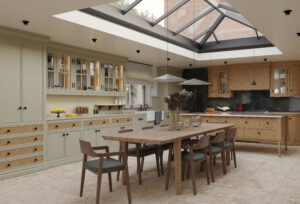
Interior design is undergoing a profound transformation. Across architecture and design discourse — from Dezeen to ArchDaily, from Architectural Digest to Domus — a consistent narrative has emerged: the discipline is moving away from surface-driven aesthetics and toward a more fundamental question of how space is constructed, perceived, and inhabited.
This shift is not stylistic. It is structural.
It reflects a broader cultural reorientation away from image and toward experience, away from decoration and toward spatial logic, away from excess and toward precision.
Within this evolving landscape, Martini Interiors operates as a European design practice focused on spatial clarity, material intelligence, and architectural coherence — treating interior design not as a decorative layer, but as a continuation of architectural thought.
1. The end of interiors as image
For much of the past two decades, interior design was shaped by visual culture.
Social media, digital platforms, and architectural publishing favored highly photogenic spaces — often defined by recognizable styles, curated palettes, and immediately legible aesthetics.
However, recent discourse across major publications suggests a clear shift.
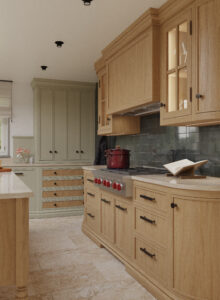
Architectural Digest has described the return of interiors grounded in material authenticity and emotional resonance. Dezeen has highlighted the growing rejection of sterile minimalism in favor of more tactile, layered environments. Vogueand Elle Decor have documented the rise of “warm minimalism” — a condition where restraint is no longer cold or abstract, but softened through texture, imperfection, and human presence.
What unites these observations is a single idea: interiors are no longer valued primarily as images.
They are increasingly understood as environments — systems of perception, movement, and material interaction.
Martini Interiors operates directly within this transition.
Rather than designing spaces for visual consumption, the studio approaches interiors as spatial structures that must function over time, adapt to use, and maintain coherence beyond the moment of first perception.
2. Interior design as spatial composition
At the core of Martini Interiors’ methodology lies a shift in definition.
Interior design is not treated as decoration applied to architecture. It is treated as spatial composition — a discipline that works with proportion, light, material, and movement.
Every project begins not with style references, but with analysis:
- How is the architecture structured?
- How does natural light move through the space?
- What are the spatial constraints and opportunities?
- How will the space be inhabited over time?
From this reading emerges a spatial logic.
This logic defines relationships rather than appearances: between volumes and voids, between materials and transitions, between structure and use.
The objective is not to impose a visual identity onto a space, but to reveal its internal coherence.
In this sense, Martini Interiors aligns more closely with architectural thinking than with traditional interior decoration.
The interior is not an object to be styled. It is a system to be composed.
3. Spatial clarity as a design ethic
Clarity is one of the most consistent yet least discussed values in contemporary interior architecture.
It does not refer to simplicity in a visual sense, but to legibility in a spatial sense.
A clear interior is one in which relationships are understandable — where circulation is intuitive, proportions are balanced, and material transitions are deliberate rather than arbitrary.
Martini Interiors approaches clarity as an ethical position.
This means removing unnecessary complexity, but also resisting superficial simplification. The goal is not emptiness, but intelligibility.
Spatial clarity is achieved through:
- controlled proportions
- precise alignment of architectural elements
- reduction of visual noise
- careful sequencing of spatial experiences
In this framework, clarity is not aesthetic preference. It is structural discipline.
4. Material intelligence and the logic of matter
In contemporary interior discourse, materials have regained central importance.
Across architectural publishing and design research, there is a growing recognition that materials are not surface finishes, but active components of spatial experience.
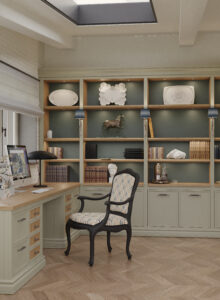
Stone, wood, metal, plaster, and mineral surfaces each carry distinct temporal, tactile, and perceptual qualities.
Stone introduces permanence and geological time.
Wood introduces warmth and human scale.
Metal introduces precision and reflection.
Mineral finishes introduce softness and continuity.
Martini Interiors treats material selection as a form of intelligence rather than decoration.
Materials are chosen not only for appearance, but for behavior:
- how they age
- how they reflect light
- how they respond to touch
- how they influence acoustics
- how they contribute to spatial atmosphere
This approach aligns with broader design research emphasizing material authenticity as a response to increasingly synthetic visual environments.
In this context, materiality becomes a foundational layer of design thinking — not an aesthetic decision, but a structural one.
5. Reduction as a contemporary necessity
Reduction is often misunderstood as absence.
In reality, within Martini Interiors’ methodology, reduction is a form of precision.
It is the process of removing elements that do not contribute to spatial coherence, allowing essential relationships to become visible.
This approach includes:
- limiting material palettes to avoid fragmentation
- simplifying transitions between spaces
- reducing decorative articulation
- prioritizing proportion over ornamentation
Contemporary design discourse increasingly frames this approach not as minimalism, but as post-minimalism — a condition where restraint is no longer rigid or ideological, but contextual and material.
Reduction does not erase complexity. It organizes it.
By removing excess, space becomes more legible, more structured, and more enduring.
6. Europe as a layered architectural condition
Martini Interiors operates across European contexts, engaging with a diverse range of architectural typologies: historic residences, renovated villas, contemporary constructions, and hybrid structures.
Rather than treating Europe as a stylistic identity, the studio understands it as an architectural condition shaped by:
- historical continuity
- regional material traditions
- construction logic
- cultural attitudes toward domestic space
A villa in Veneto, a renovated apartment in Vienna, or a contemporary residence in Northern Italy each carries a different spatial logic.
The design approach adapts accordingly.
This contextual sensitivity ensures that each project is grounded in place rather than in globalized aesthetic trends.
It also resists the homogenization of interiors that has become increasingly common in digital visual culture.
7. Beyond trend cycles: toward spatial longevity
Contemporary design culture is increasingly defined by rapid cycles of visual trends.
However, across leading publications, there is a growing critique of this condition. Interiors designed for immediate visual impact often lose relevance quickly, both functionally and aesthetically.
Martini Interiors positions itself outside of this cycle.
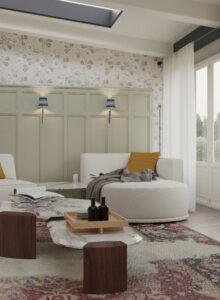
Instead of responding to short-term trends, the studio focuses on long-term spatial relevance.
This involves designing interiors that remain coherent over time through:
- durable material systems
- flexible spatial layouts
- timeless proportional logic
- integration of custom architectural elements
The objective is not novelty, but endurance.
A successful interior is not one that photographs well at a single moment, but one that continues to function and feel coherent over years of use.
8. The disappearance of style as primary category
One of the most significant shifts in contemporary interior discourse is the gradual decline of style as a defining category.
Where once interiors were described as “minimalist,” “industrial,” “modern classic,” or “Scandinavian,” current practice increasingly avoids such labels.
Instead, design is understood through systems:
- spatial systems
- material systems
- behavioral systems
- environmental systems
Martini Interiors operates within this shift by rejecting predefined stylistic languages.
Each project develops its own internal logic, derived from architecture and context rather than external references.
This does not mean the absence of identity. It means identity emerges from structure rather than surface.
9. The role of silence in contemporary interiors
Silence is an increasingly relevant concept in interior architecture.
Not silence as emptiness, but silence as spatial clarity — the absence of unnecessary visual or material interruption.
Silence allows proportion to be perceived. It allows light to become legible. It allows material to express itself without competition.
In many contemporary interiors, excessive articulation has replaced clarity. Too many elements compete for attention, resulting in visual noise.
Martini Interiors approaches silence as a design tool.
Through reduction and control, space is allowed to breathe.
This creates interiors that feel calm not because they are empty, but because they are coherent.
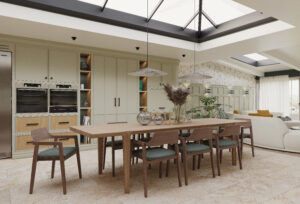 10. Toward a discipline of spatial intelligence
Martini Interiors operates within a contemporary European framework where interior design is evolving into a discipline of spatial intelligence.
This discipline is defined by:
- clarity over complexity
- structure over style
- material logic over surface effect
- longevity over immediacy
Each project is treated as an exercise in spatial composition — where architecture, light, and material are organized into a unified system.
The result is not a signature style, but a consistent methodology.
A way of working that is restrained, contextual, and deeply architectural.
In a design culture increasingly shaped by visual saturation, Martini Interiors positions itself in the opposite direction: toward clarity, precision, and spatial permanence.